
What Is the Mix Engineer Role in Music Production
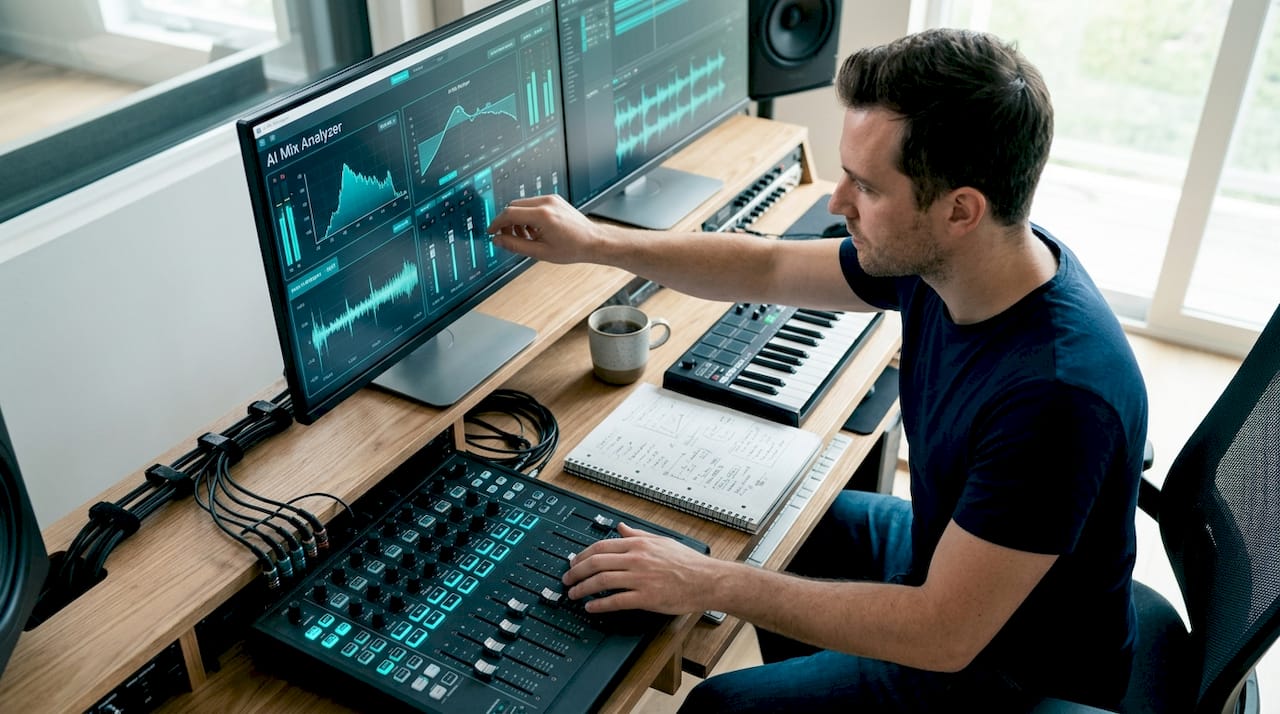
Most people assume a mix engineer just turns knobs and adjusts sliders. That assumption undersells one of the most consequential roles in the entire music production chain. Understanding what is the mix engineer role means recognizing that these professionals make hundreds of micro-decisions that collectively determine whether a song feels alive or flat. They are the reason a track sounds polished on earbuds, car speakers, and a club sound system simultaneously. If you are an aspiring producer or independent musician, knowing what this role actually involves will change how you approach every session.
Table of Contents
- Key takeaways
- What is the mix engineer role and why it matters
- How to prepare your tracks for a mix engineer
- Tools and techniques that define professional mixing
- Mixing vs. mastering and other audio roles
- My take on what mixing really demands
- Hear what your mix is actually doing
- FAQ
Key takeaways
| Point | Details |
|---|---|
| Mix engineers shape emotional impact | They balance, process, and sculpt audio tracks to make songs clear, immersive, and emotionally resonant. |
| Mixing and mastering are separate stages | Mixing balances individual tracks; mastering polishes the final stereo file for distribution. |
| File preparation directly affects quality | Sending well-labeled, properly formatted files reduces friction and improves the final mix. |
| Mix engineers use both art and science | EQ, compression, panning, and automation are technical tools applied with creative judgment. |
| Understanding the role helps you collaborate | Knowing what a mix engineer needs from you produces better results and faster turnaround. |
What is the mix engineer role and why it matters
A mix engineer, also called a mixing engineer, is the professional responsible for combining separate audio tracks into a single, balanced, and cohesive final mix. They work after recording is complete and before mastering begins. Their job is not simply technical cleanup. It is a creative process that shapes the sonic identity of a song.
Here is what the core mixing engineer responsibilities actually look like in practice:
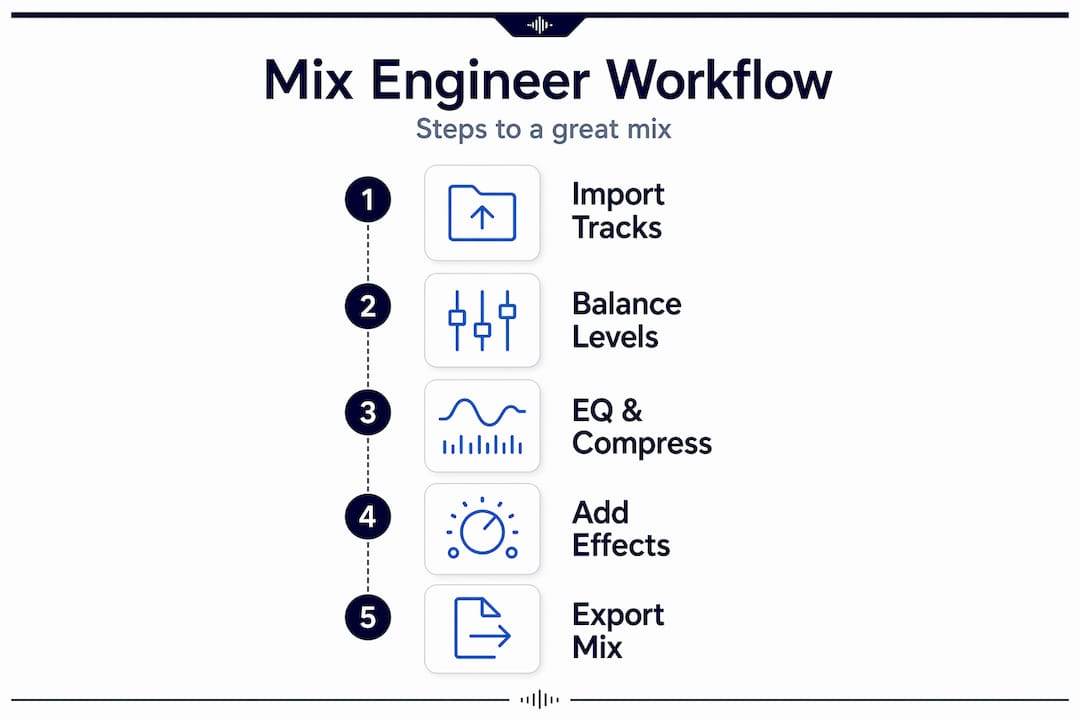
- Balancing volume levels across every track so no element drowns out another. A lead vocal sitting too low in the mix, for example, can make a well-written song feel amateur.
- Panning instruments across the stereo field to create width and separation. Drums, guitars, synths, and vocals each occupy a defined space.
- Applying equalization (EQ) to carve out frequency space for each instrument. Without this, low-end instruments like bass and kick drum collide and create what engineers call “mud.”
- Using compression to control dynamic range, keeping loud moments from overwhelming quiet ones and giving the mix energy and punch.
- Adding effects like reverb, delay, and saturation to create depth, warmth, and atmosphere.
- Writing automation so elements move, breathe, and evolve throughout the song rather than sitting static.
- Checking translation across multiple playback systems, from studio monitors to phone speakers, to confirm the mix holds up everywhere.
What separates mixing from recording is focus. A recording engineer captures sound. A mix engineer shapes it. What separates mixing from mastering is scope. Mixing balances individual tracks; mastering optimizes the final stereo file for loudness, consistency, and distribution.
Pro Tip: Before sending a mix to a mastering engineer, run it through an AI analysis tool to catch frequency imbalances and dynamic issues you may have stopped hearing after hours of work.
How to prepare your tracks for a mix engineer
Understanding what does a mix engineer do is only half the picture. Knowing how to set them up for success is equally important. The quality and clarity of files you provide directly influence mix quality and efficiency. Sloppy file delivery is one of the most common ways independent musicians slow down their own projects.
Here is what professional file preparation looks like:
- Export at 24-bit/48kHz WAV. This is the industry-standard format for mixing. Lower bit depths and compressed formats like MP3 reduce the headroom a mix engineer needs to work with.
- Start every track at bar 1, beat 1. All files must begin at the same point in the timeline so the engineer can drop them into any DAW and have everything align instantly.
- Label tracks clearly and consistently. “Guitar_Lead_Verse,” not “Track 07.” Ambiguous names force the engineer to guess, which costs time and introduces errors.
- Match mono and stereo files correctly. A mono source like a close-mic’d snare should be a mono file. A stereo synth pad should be stereo. Sending mono content as a stereo file wastes space and can create phase issues.
- Include your aux send effects. If you have a reverb or delay on a send channel, bounce that as a separate track. Mix engineers need aux effects to understand your artistic intent and decide whether to keep, modify, or replace them.
- Write notes. Tell the engineer what the song is about, what references inspired it, and any specific requests. Communication is part of collaboration.
One detail producers often overlook: mix engineers frequently create their own submix groups once they receive your files. They will organize drums, bass, vocals, and instruments into separate buses for precise control. You do not need to do this for them, but understanding it helps you see why clean, separated files matter so much.
Pro Tip: Include a rough mix of your song when sending files. It gives the engineer a clear picture of your vision without limiting their creative decisions.
Tools and techniques that define professional mixing
Mix engineers work inside a DAW (digital audio workstation) and rely on a combination of technical processors and creative instincts. The tools themselves are not magic. The skill is in knowing when and how to use them.

The core processing toolkit
| Tool | What it does | Common use case |
|---|---|---|
| Equalization (EQ) | Cuts or boosts specific frequencies | Removing low-end rumble from vocals; adding presence to guitars |
| Compression | Controls dynamic range | Taming a loud snare hit; gluing a drum bus together |
| Reverb | Adds spatial depth and room feel | Placing vocals in a virtual space; creating atmosphere |
| Delay | Creates echo and rhythmic texture | Adding movement to a guitar line; widening a vocal |
| Saturation | Adds harmonic warmth and edge | Making digital synths feel analog; adding grit to a bass |
| Automation | Changes parameters over time | Riding vocal levels; opening a filter on a synth pad |
Beyond the tools, mix engineers apply EQ to remove frequency conflicts, which is one of the most misunderstood skills in audio production. When a bass guitar and a kick drum both carry energy around 80Hz, they compete. The engineer uses EQ to carve space for each, so both feel present without masking each other. This is called frequency management, and it is one of the primary reasons professional mixes sound clear where home recordings sound cluttered.
Panning deserves more credit than it typically gets. Placing a hi-hat slightly right, a rhythm guitar hard left, and a lead guitar at 30% right creates a three-dimensional image that pulls the listener in. It is not random placement. It is a deliberate map of sonic space.
Automation is where mixing crosses fully into art. Mix engineers make hundreds of small decisions that accumulate into the final record. A vocal that rises slightly in volume at the emotional peak of a chorus, a reverb tail that fades as the verse begins, a filter sweep that builds tension before a drop. None of these are obvious to the listener, but all of them are felt.
Mixing vs. mastering and other audio roles
The mix engineer’s position in the production chain is specific and non-interchangeable. Confusing it with other roles leads to unrealistic expectations and miscommunication.
- Producer vs. mix engineer: A producer shapes the creative direction of a song during recording and arrangement. A mix engineer takes the recorded material and makes it sound its best technically and sonically. Sometimes one person does both, but they are distinct skill sets.
- Recording engineer vs. mix engineer: The recording engineer sets up microphones, manages gain staging, and captures performances. The mix engineer works with what was captured, not during the capture itself.
- Mix engineer vs. mastering engineer: Mastering engineers provide fresh, objective ears after mixing is complete. They optimize loudness, apply final EQ and limiting, and prepare the file for streaming platforms, vinyl, or broadcast. They work on the stereo mix as a whole, not individual tracks. You can explore the mixing vs. mastering distinction in depth if this area still feels unclear.
Understanding where mixing fits helps you budget your time and money correctly. Skipping a dedicated mix engineer and going straight to mastering is like painting over a rough wall and expecting it to look smooth. Mastering cannot fix a bad mix. It can only refine a good one.
My take on what mixing really demands
I have worked around music production long enough to know that most newcomers underestimate what mixing actually requires. They hear a polished record and think the quality came from expensive gear or a famous producer. Rarely. It came from a mix engineer who spent hours making decisions the listener will never consciously notice.
What I find most interesting about this role is the patience it demands. Mix engineers process and balance audio through hundreds of minute decisions over hours. That is not a job for someone who wants immediate gratification. It rewards people who can hear the same 16 bars fifty times and still catch something new.
The other thing I have come to appreciate is how much the mix engineer depends on the producer or musician to communicate clearly. I have seen technically excellent engineers struggle because the artist sent disorganized files with no notes and no reference tracks. The best collaboration happens when both sides understand their responsibilities.
If you are serious about a career in audio mixing, start by listening analytically. Pull apart records you love. Ask yourself why the bass sits where it does, why the vocal feels close or distant, why the chorus hits harder than the verse. That curiosity is the foundation everything else builds on.
— Uygar
Hear what your mix is actually doing

Most mix problems are invisible until you know where to look. Mixanalytic’s Free Mix Analyzer uses 17 AI-powered audio analysis modules to show you exactly what is happening in your frequency balance, dynamic range, and stereo field. You get the kind of feedback that used to require a professional studio session, delivered in minutes. If you want to go deeper into production techniques, the Immersive Audio Guide covers everything from spatial audio fundamentals to advanced mixing workflows. Thousands of independent musicians and producers already use Mixanalytic to catch problems before they reach mastering.
FAQ
What does a mix engineer do exactly?
A mix engineer combines and processes individual audio tracks using EQ, compression, panning, effects, and automation to create a balanced, polished final mix ready for mastering.
How is a mix engineer different from a mastering engineer?
Mixing works on individual tracks to create a cohesive song; mastering works on the final stereo mix to optimize loudness and prepare it for distribution. They are sequential stages, not interchangeable ones.
What skills does a mix engineer need?
A mix engineer needs a trained ear for frequency and dynamics, proficiency in a DAW, knowledge of signal processing tools, and the creative judgment to make technical decisions serve the emotional goals of a song.
What file format should I send to a mix engineer?
Send 24-bit/48kHz WAV files with all tracks starting at bar 1, beat 1, clearly labeled, and with mono and stereo files matched correctly to their source.
Can a producer also be a mix engineer?
Yes, many producers handle their own mixing, especially in independent music. However, mixing is a specialized skill, and having a dedicated mix engineer often produces a more objective and polished result.